Bluefin tuna catch and release: how to do it right
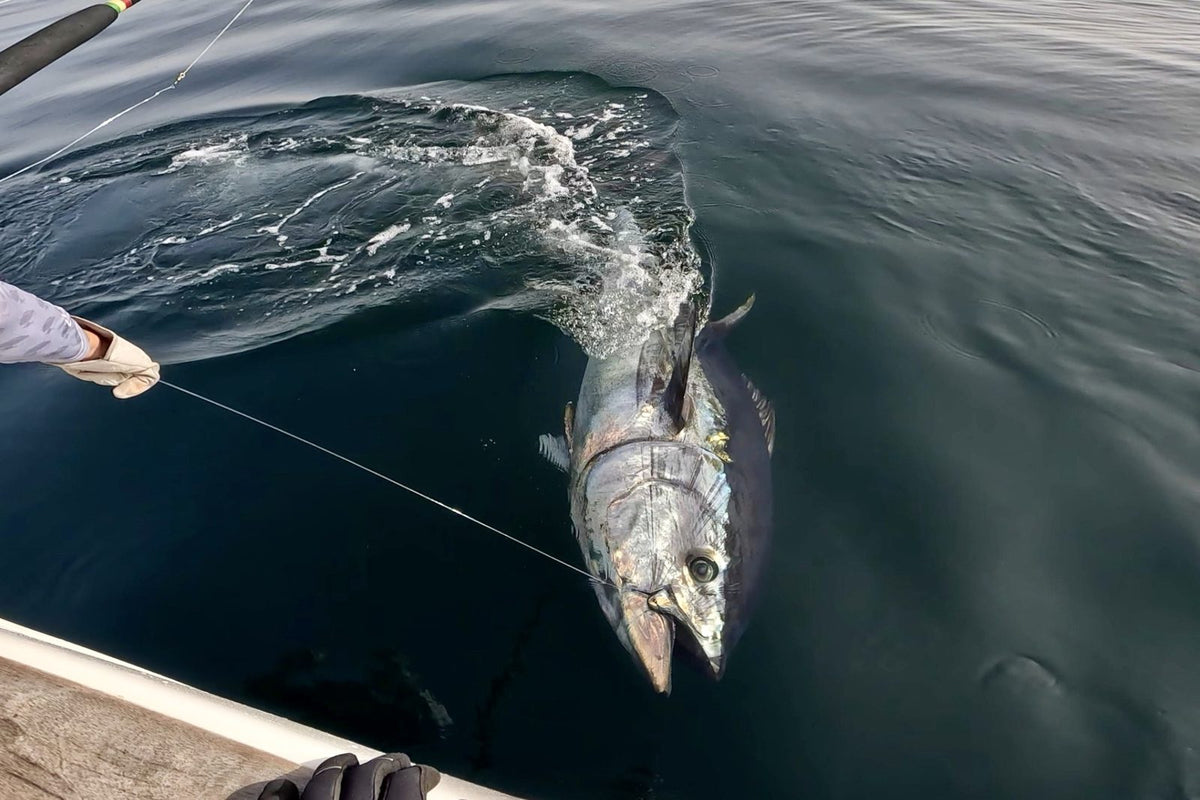
In European recreational fishing, bluefin tuna is in most cases a catch-and-release fish: quotas are limited and keeping one requires specific authorisation. Check your country's rules every season; in Spain they are published by the Ministry of Agriculture, Fisheries and Food. Whatever the rule, releasing a tuna well is a skill you learn, and this is the foundation.
1. The fight: the shorter, the better
An exhausted tuna builds up lactic acid and its survival drops. Use gear matched to the fish, a firm drag and work with the boat to shorten the fight. Fighting for half an hour on light tackle may look sporting, but for the fish it is the worst thing.
2. Alongside the hull, not on board
Ideally, do not take the fish out of the water. With the tuna alongside, one person holds the leader with gloves while another works the hook with a long dehooker or pliers. If the hook is deep and will not come out cleanly, cut the leader as close as possible to the hook: a hook rusts and falls out in weeks; a torn throat does not heal.
3. Hooks that help
- A single hook comes out in seconds; a double or a treble almost never without damage.
- Crushing the barb with pliers barely costs hook-ups and multiplies clean releases.
- Replace rusty or bent hooks before you go out.
4. What you do not touch
No fingers in the gills or the eyes, and never hang the fish by the tail or the jaw. If its size means you have to lift it to unhook, do it on a wet surface, with gloves and in the shortest possible time, counting seconds, not minutes.
5. Reviving
Before letting go of the leader, check that the fish swims on its own. If it is stunned, hold it with the boat at very slow speed, facing the current, so water flows through its mouth. When it responds strongly and tries to leave, let it go. This is when you are glad the camera was ready beforehand rather than being looked for now.
What you need on board
- Grip gloves and a long dehooker or long-nose pliers.
- Leader cutters at hand, not in the box.
- A plan: who holds the leader, who unhooks, who drives the boat.
What the science says
Releasing properly works, and it has been measured. In the study presented to ICCAT by Marcek and Graves (Virginia Institute of Marine Science, 2014), 20 satellite tags were fitted to bluefin tuna of 119 to 169 cm caught trolling with J-hooks off the US east coast: 19 tags reported and all 19 fish survived the 31-day tracking period, a post-release mortality of 0% (95% confidence interval: 0–10%). The authors conclude that the recreational catch-and-release troll fishery “does not represent a significant source of fishing mortality” for juvenile bluefin. The FAO Technical Guidelines for Recreational Fisheries (No. 13, 2012) record what any experienced skipper already knows: barbless hooks shorten unhooking and reduce tissue damage at the entry point, and air exposure should be avoided whenever possible, because the gill lamellae collapse out of the water.
The rules in Spain (2026 season)
- Recreational fishing targeting bluefin tuna is allowed only as catch and release, from 16 June to 14 October 2026, or earlier if the quota runs out.
- You need the recreational sea-fishing licence plus a specific authorisation, requested only through the Ministry's PescaREC app (mandatory since March 2026).
- Every catch and release is declared in PescaREC within 24 hours of the trip.
- Competitions and tournaments that kill bluefin tuna are prohibited.
- If a fish reaches the boat dead, only one per vessel per day may be kept, with a maximum of two per season, whole, with prior notice and never for sale. Out of season, any tuna goes straight back into the sea.
Legal basis: Royal Decree 46/2019, Royal Decree 362/2026 and the annual resolution of the Secretaría General de Pesca. In Portugal, Italy or France the national fisheries authority publishes its own conditions every year: check them before you go out.
This is one of the commitments on our page Our commitment: if we fish tuna, there should still be tuna.
Sources
- Marcek, B. J. and Graves, J. E. (2014). Post-release mortality of school-size Atlantic bluefin tuna in the U.S. recreational troll fishery. Collect. Vol. Sci. Pap. ICCAT, 70(2): 654-662. PDF at iccat.int
- FAO (2012). Recreational fisheries. FAO Technical Guidelines for Responsible Fisheries No. 13. PDF at fao.org
- Spanish Ministry of Agriculture, Fisheries and Food: recreational sea fishing FAQ and PescaREC.